All Top Banking

Showing posts with label PIN Debit. Show all posts

KPG Ventures Funds Nat'l Payment Card

Posted by John B. Frank Wednesday, February 4, 2009 0 comments


I wrote about National Payment Card earlier this year. Why $4.00 a Gallon Gas is More Appealing to NPS.   Now comes word that they've raised $2 million for expansion, so apparently KPG Ventures found something very appealing about their decoupled debit program.  Here's the press release:

KPG Ventures Funds National Payment Card Association With $2 Million for Expansion Into Supermarket and Chain Drug Verticals

SAN FRANCISCO--(BUSINESS WIRE)--KPG Ventures—a venture capital firm specializing in seed-stage disruptive technology companies, today announced it has invested $2 million in National Payment Card Association, an emerging company responsible for creating a large scale, low cost debit settlement system benefiting consumers and merchants with lower transaction fees. KPG Ventures’ investment will propel National Payment Card Association’s growth beyond the fuel and convenience markets and into supermarkets and chain drug outlets.

National Payment Card Association’s technology is currently being deployed in fuel and convenience stores across the country, allowing consumers to save money and merchants an alternative to the large transaction processing fees charged by traditional transaction processors.

“National Payment Card Association’s product is an innovative, money-saving concept that has already met with a great deal of success,” said National Payment Card Association CEO and Founder Joe Randazza. “In these difficult times, the support and vote of confidence we have received from a specialized venture capital firm like KPG Ventures is validation of our model and technology, and well positions us for future growth.”

“KPG seeks investments that can scale and solve a highly defined consumer problem and found both of them in National Payment Card Association,” said Dave Hills, a General Partner of KPG Ventures. “Joe and the team have built a great product and we’re happy to support them.”

National Payment Card Association first introduced its alternative payment solution in June 2006 and has earned much attention from industry insiders and consumers. The National Payment Card Association PIN based payment system processes transactions through the Federal Reserve Automated Clearing House (ACH), resulting in lower merchant fees and a self-funded loyalty program that can provide immediate savings to consumers. Specifically, the program benefits retailers by helping them shift away from the interchange fees credit card companies normally charge on each transaction by moving them to the lower cost ACH system. The merchant can then use some of the savings to change customers’ payment behavior by passing some of that savings along to them right at the pump.

Founded in 2006, KPG Ventures is a San Francisco-based venture capital firm. KPG focuses on the consumer Internet sector of technology-driven businesses, investing at the seed-stage cycle of a company’s development. With a proven track record of picking the right companies and teams who are focused on highly capital efficient opportunities that require little capital to reach profitability, KPG has launched many successful companies. The firm concentrates its efforts on a small handful of companies at a time so that it can leverage the strategic and operating expertise of its general partners.

For more information about KPG Ventures, please visit kpgventures.com. For more information on National Payment Card Association, please visit nationalpaymentcard.com or contact Shep Doniger at 561-637-5750.


Reblog this post [with Zemanta]

The Benefits of Debit Cards by Bruce Cundiff via DebitFacts.org

Posted by John B. Frank Thursday, October 30, 2008 0 comments

DebitFacts.org - Ask The Expert
Ask The Expert
Bruce Cundiff
Javelin Strategy & Research


Paying and Accessing Your Money with Debit: A Safe and Convenient Alternative to Cash

The debit card has emerged as a payment method of choice for many American consumers, with 72 percent using debit cards for purchases in the past 12 months, according to Javelin Strategy & Research1. In 2007, there were nearly 31 billion debit transactions at the point of sale, totaling purchase volume of $1.2 trillion2. These statistics highlight consumers’ preference for using debit cards when making purchases at the point of sale, and with good reason. Debit cards provide a safe and efficient method of payment with multiple benefits over more traditional types of payments such as cash and checks.

Recent media coverage of debit card use among consumers has focused largely on the perceived lack of security when using debit cards. This article provides a factual source of information to enable consumers to make informed choices and make the most of their debit cards.

Safe and Secure Access - Reducing Fraud at the Point of Transaction

Debit card fraud is not spiraling out of control, as many in the media would have consumers believe.

Debit card networks, financial institutions that issue debit cards, ATM owners, and merchants that accept debit cards at their points of sale, are constantly making improvements to ensure that debit card transactions are secure, and that they quickly and efficiently remedy any issues that may arise - fraudulent transactions or otherwise. Despite reports to the contrary, fraud rates for debit cards remain relatively low. According to the 2008 Debit Issuer Study, commissioned by the PULSE® ATM/debit network, debit card fraud losses at ATMs were, on average, 2.5 cents per transaction in 2007. The fraud-loss rate was lower at the point of sale, with an average fraud loss of 2.1 cents per transaction when the cardholder used a signature and even lower - only half a cent - when the cardholder used a personal identification number (PIN) to complete the transaction.

Fraud Prevention and Assistance

Should consumers become victims of debit card fraud, however, financial institutions work hard to ensure that the cardholder is made whole again. Limited liability was developed with consumer protection in mind. Unlike with cash, limited liability means that if a consumer’s debit card is lost or stolen, consumers have a chance to get their lost funds back. With stolen cash, once it’s gone, there is little chance of recovering it.

The amount consumers are liable for depends on how quickly the financial institution is informed of the illegal activity. Consumers should check with their individual financial institution for specifics on the level of protection provided.

In most cases, debit card issuers often limit consumer fraud loss exposure to $50. Javelin’s Identity Safety Scorecard, a survey of the security mechanisms the top U.S. financial institutions have in place, indicates that most issuers effectively have a "zero liability" policy. This means that consumers are not responsible for any fraudulent transactions initiated on their accounts3, as long as they report the transactions within a given time frame - usually within 60 days of when the fraudulent transaction was discovered.

Limited liability highlights the benefits of debit over cash. With limited liability for a lost or stolen debit card, consumers have a measure of protection as compared to the "final" nature of lost or stolen cash - once it’s gone, there is little chance of recovering stolen cash.

Debit Cards as a Financial Management Tool

Given the current economic climate, consumers are increasingly seeking assistance from their financial institutions for help with financial management and spending control. Debit cards offer an element of control for consumers in that the money spent in a debit card transaction is drawn from existing funds in their account. Account holders often view debit cards as a vehicle to control their finances and spend responsibly. Since the funds from debit card transactions come out of a bank account or credit union and are not borrowed from a line of credit, it is important to keep track of account balances and how much is being spent to avoid overdrafts and associated fees.

With debit cards, though, keeping track of balances is easier than ever. In addition to available balance information provided on many ATM transaction receipts, online banking allows consumers to check balances and transactions 24/7. Many financial institutions also offer e-mail alerts that can be set up to notify consumers when their balances reach a certain threshold - often defined by the consumers themselves.

There are instances when using a debit card will cause a hold on funds in the account to cover the anticipated amount of the transaction. Financial institutions can place a hold on an account as a means of ensuring payment to the merchant. This "preauthorization" has attracted a significant amount of attention recently as consumers use their debit cards more frequently at gas stations, where holds are common. With gas prices rising dramatically over the past year, merchants are now submitting a preauthorization request to confirm that funds of $50 to $100 are available to cover the cost of a tank of gas.

Financial institutions that issue debit cards are responsible for actually applying the hold, as well as setting the length of the hold, which varies depending on how the debit card is used (PIN or signature transaction). The amount of money in the account available for use during the hold period is reduced by the amount of the hold. To avoid potential overdraft fees that could arise from a hold at the point of sale, consumers should check with their financial institution to determine its policy on the length of debit holds. If a hold lasts longer than an hour for a PIN transaction, or a few days for a signature transaction, ask why.

A Small Price for a Great Convenience

Contrary to some inaccuracies that have been reported, there is rarely a service charge passed on to customers when using debit cards to make purchases. In fact, less than 1 percent of cardholders in the U.S. are charged a fee by their financial institutions for using a PIN-based debit card for purchases.4

While some financial institutions are adding surcharge-free ATM access, most ATM owners charge a fee of $1 to $3 for withdrawing money from an ATM not owned by the account holder’s financial institution. This charge, like the premium paid for valet parking or to drive tollways, is for the convenience of getting cash from an ATM owned by an organization other than the debit cardholder’s financial institution.

To avoid the surcharge fee, consumers can use the cash-back option at available merchants or get cash from their financial institution’s ATMs.

Bruce Cundiff is Director of Payments Research and Consulting with Javelin Strategy & Research - a leading provider of nationally representative, quantitative research focused exclusively on financial services topics.


Reblog this post [with Zemanta]

Identity Theft: More Likely if You Speak English

Posted by John B. Frank Monday, October 27, 2008 0 comments


SAN JOSE, Calif. - (Business Wire) Online consumers in English-speaking countries are the most frequent victims of identity theft, twice the rate of France, Germany and Spain, according to a new study released by PayPal. With the holiday season fast approaching, three quarters of online shoppers worldwide are concerned about online scams or identity theft. The research, conducted by Ipsos, examined online security fears and habits in the United States, Canada, France, Germany, Spain and the United Kingdom.

The survey found that 10 percent of online shoppers in Canada, the U.S. and the U.K. had experienced identity theft. This compares with only five percent in France, Germany and Spain. Approximately 25 percent of online shoppers in the three English-speaking countries knew friends or family who had their identities stolen.

This survey shows that while concerns about ID theft form a universal language, more identity theft tends to occur in countries where a higher percentage of e-commerce is concentrated,” said Michael Barrett, chief information security officer for PayPal. “But e-commerce is growing in prominence around the world, and fraudsters will likely follow the money. Consumers everywhere can stay one step ahead and better protect themselves online by following a few simple tips.”

While choosing and safeguarding passwords is one of the most important factors to online security, attitudes and behaviors vary greatly between cultures. German consumers are the most vigilant with passwords. Only about one in four (28 percent) has ever shared an account password with a family member or friend. This compares with 60 percent of Americans and 56 percent of French consumers who shared passwords. Consequently, Germans also experienced the fewest problems with identity theft -- only three percent of German consumers have experienced identity theft, and fewer than one in 10 knows someone who has.

Almost half of consumers in all countries surveyed use important dates, family member names, nicknames or pets’ names as their online passwords. French and Spanish consumers are most lax when it comes to updating their passwords. Sixty-one percent of French consumers and 63 percent of Spanish consumers change their passwords less than once per year or only when required to do so.

The survey found that about 40 percent of consumers in all six countries use social networking sites, and some of these consumers display personal information that they also use for passwords. More than one in four French consumers display their birth dates on social networking sites and also use birth dates as online passwords. Less than 10 percent of consumers in the UK and Canada do the same.

Other Global Findings


Reblog this post [with Zemanta]

Just Say No to Double-Dipping!

Posted by John B. Frank Friday, October 3, 2008 0 comments

PayPal Double-Dips with Billing Glitch; eBay Credits Coming?
By Ina Steiner
AuctionBytes.com

Some PayPal members discovered the online-payment service had "double-dipped" their accounts. PayPal waited until October 1st to post the problem on its Announcement Board, explaining that some PayPal Debit Card transactions that were initiated on September 26th were debited twice due to a processing error. "We have begun processing the corrections for the duplicate payments and they should appear in your PayPal account in the next few days. We apologize for any inconvenience this may have caused and are working to resolve this issue as soon as possible."

PayPal spokesperson Michael Oldenburg said the company would be communicating with affected customers individually by email and was working to correct the duplicate payments in the next few days. He declined to reveal how many accounts were affected by the glitch.

Meanwhile, sellers have been wondering whether eBay has issued credits yet for a glitch that caused items listed or revised on eBay between September 17 - 19 not to appear eBay Search. eBay announced the credit on its Systems Announcement Board and subsequently removed the post. Some sellers complain that they've been unable to reference it when speaking to eBay customer service representatives, some of whom are reportedly unaware that eBay promised the credits. eBay has not responded to inquiries about the credits.

Meanwhile, eBay Australia announced that buyers are having trouble redeeming vouchers.

Reblog this post [with Zemanta]

UK Cardholders Flock to Secure Their Online Payments

Posted by John B. Frank Tuesday, September 23, 2008 0 comments

September 23, 2008 by Gill Montia

Story link:
Cardholders flock to secure online payment methods

UK payment services association, Apacs, has reported a major increase in the volume of credit and debit card holders taking advantage of measures that can prevent online shopping fraud.

According to Apacs, over 25 million cards are now registered with secure online payment systems, Verified by Visa and MasterCard SecureCode. Cardholder registration in August was up 150% over the year and had increased by nearly 600% on August 2006. The process of signing up is simple and can be completed on the websites of card providers.

The schemes offer enhanced protection against the unauthorised use of a card and provide state of the art online security without the need for additional software.

Online shopping card fraud was estimated at £223.8 million in 2007, when it formed around 77% of total card-not-present fraud losses in the UK. Last year’s figure was up from 45% from 2006, when Internet fraud losses stood at £154.5 million and accounted for 73% of total card-not-present fraud losses.
Reblog this post [with Zemanta]

PaymentsSource Webinar Available for Public Viewing

Posted by John B. Frank Friday, September 19, 2008 0 comments

Last week I posted "PaymentsSource Webinar Review" about attending a webinar on a new online publication coming out from SourceMedia they call "PaymentsSource."

SourceMedia publishes American Banker, Bank Technology News, ATM & Debit Card news and more.

If you would like to view a replay of the webinar you can click below:

take me to the replay now

Reblog this post [with Zemanta]

Contactless and Clueless

Posted by John B. Frank Wednesday, September 17, 2008 0 comments

Despite the fact that over 90% of Americans that own contactless payments cards like using them, three quarters of the population are not even aware of the technology's existence, according to a survey commissioned by the Smart Card Alliance.

Javelin Strategy and Research surveyed 500 contactless card users, finding that 92% think the technology is fast and easy to use. Respondents also use their cards regularly - with over 22% making payments with their contactless cards more than six times per month.

Contactless card users are also keen on mobile payments. The research found 43% are likely to use a handset as a mobile wallet, compared to just 19% of people who don't use contactless cards.

Nearly half - 47% - of contactless card owners would even switch carriers in order to make mobile payments.

The technology is rapidly gaining in popularity, with nine percent of the US population now possessing a contactless card. Last year the number of open network contactless cards in circulation reached 35 million, nearly double the 19 million in 2006.

Merchants are also adopting the technology, with an estimated 75,000, including taxi firms and transport operators as well as retailers, now accepting the cards.

"Contactless payment acceptance at merchants is taking off much faster than PIN debit did," says John Suchanec, SVP, payment research and innovations, Bank of America. "Contactless acceptance is already growing at a rate that it took seven years to achieve with PIN debit. Mobile will accelerate the curve."

But Javelin also questioned 1500 people representative of the US online population (not necessarily contactless card users) and found awareness of the technology is still poor.

Only a quarter of those surveyed are familiar with contactless, although this is up from 15% in 2006.
Reblog this post [with Zemanta]

Who's Afraid of the Big Bad Web?

Posted by John B. Frank Thursday, September 11, 2008 0 comments

With the price of fuel hovering at all time highs, many people have started counting the cost of the "shopping expedition" as well as the price of merchandise.

This has created the beginnings of a paradigm shift in the behavioral pattern of consumers and how they shop for goods.

Recent stories raising consumer awareness on the potential of becoming a victim to card cloning, card skimming, Wardriving, etc. etc. only adds to the momentum to forces driving consumers to shop online.

After all, online shopping literally eliminates the fuel factor, having one's own personal swiping device complete with PIN Entry capability virtually eliminates the potential for fraud and e-Commerce pricing usually beats anything found in bricks and mortar locations...and it always will. It simply costs less to provide an outlet of goods online and in the competitve landscape of such a world, those savings are passed on to consumers. In fact, according to an article published today in Red Orbit entitled: Sale of the Century Bargains are one of the biggest allures online retailers have to offer. Here's an excerpt:

"
Part of the internet's popularity is down to its reputation for being the easiest place to bag a bargain. Falling broadband costs, a greater familiarity with e-shopping and increasing online offers mean it looks set to thrive, even against the backdrop of the credit crunch. In fact, online shoppers are buying more regularly than ever before: an average of 16.9 times each per year, an increase of 2.7 purchases each in 2006. This continues to force retailers of every type and size to use the format as part of the way they do business".

Thus, e-Commerce is booming worldwide, not just here in the States.

Therefore it is critical that companies begin to look at how to use the internet to drive sales. Not only should companies utilize the internet for marketing purposes, but they should look at it as a critical sales channel. The numbers speak for themselves. This is not a trend. It is truly a paradigm shift.

Consumers armed with high-speed access and positive online retail experiences are increasingly comfortable shopping online. Metrical analysis of the United States and Europe show trends of increased spending in online retail from last year, and the rate of transition from traditional to online shopping isn't showing signs of slowing down anytime soon. In fact, it's outpacing bricks and mortar, while percentages of online shoppers increase. (see "related stories" below)

e-Commerce is expected to boom for the next 5 years. I say longer. I say paradigm shift.

I say that the web is retail's big bad wolf and it's gonna huff and puff and blow some houses down. Bricks...and...mortar...and... all....oh my.

Kudos to the company that houses the global patent on bringing PIN Debit to the web in a browser environment! It's the most popular and fastest growing payment platform in the bricks and mortar world and has yet to take a foothold in the online payments space. That's about to change however and online retailers will jump at the opportunity to significantly reduce their payment processing costs, risk management, chargebacks and increase the security of the transaction. It's not if, it's when. Period.


Related articles by HomeATM PIN Debit Blog

PIN Debit Has Highest Growth of All Payment Segments

Posted by John B. Frank Wednesday, September 10, 2008 0 comments


First Data Releases Their 21st Annual Consumer Payment Usage Study.


This fourteen page report reports on trends, segmentation opportunities with special focus on six different POS payment categories that consumers tend to be most comfortable: Signature Debit, PIN Debit, Cash + PIN Debit, Cash Only, Check Only and Credit Card.

Not surprisingly PIN Debit is "experiencing the most growth"
while checks have experienced the greatest decline. The report correlates other payment behavior for each payment category such as bill payment behavior, internet purchases, security concerns and more.


Here are some highlights of the study. As always, click any graphic to enlarge it to full size. To read the study in it's entirety, follow this link:

First Data Consumer Payment Usage Study


Executive Summary

For the 21st consecutive year, First Data conducted an annual consumer study to understand and track changes in consumer attitudes and behaviors toward various payment methods. The intent of the annual study is to learn more about critical information for retaining customers, acquiring new customers, differentiating products and services and producing a higher rate of return for businesses. The 2007/2008 Consumer Payments Usage and Segmentation Study revealed key trends that merchants may want to consider in marketing and utilizing ATM/debit cards and related products.

ATM/Debit Card Use Continues to Grow The frequency of using an ATM/debit card increased from 2006 to 2007 with more consumers reporting using their card in the past 30 days. Of particular note is the substantial 11 percent increase (63 percent in 2007 up from 52 percent in 2006) in past 30-day card use by the 61+ age group. In general, the reported number of times an ATM/debit card is used in the past 30 days continues to edge up slightly and is slowly approaching usage level of once per day. According to the survey, usage levels of ATM/debit cards are driven mostly by POS use.

Compared to 2006, the two segments of PIN Debit and Signature Debit comprised a larger share of the marketplace in 2007. This is likely due to consumers gaining more familiarity with electronic payment methods, prolific accessibility to ATM/debit cards and attraction toward the speed, convenience and protection offered by ATM/debit cards relative to traditional payment methods, such as checks. The PIN Debit segment records the highest growth of all segments and is now almost equal in size to the Cash segment, which also posted an increase, though marginal.

PIN Debit Segment – Changes Versus 2006


The PIN Debit segment mainly comprises consumers 25 to 60 years. However, in 2007, the proportion of customers age 61 years and older in this segment increased slightly. A gender concentration shift also occurred as more women than men now form a larger part of this segment. Though security remains the top reason users report for preferring PIN debit, speed (faster/quicker) gained ground as a reason in 2007.


25% of the World's Population Use the Internet Regularly


To expand on my post a couple weeks back entitled: "HomeATM Has Powerful Potential, I bring you this article from VUNet.com on Global Internet use. But before I do, I thought it important to point out the distinction between Web PC users and "web enabled" users. There's two sets of numbers out there.


These numbers include "web enabled" users and provide some insight as to not only the size of our potential market, but why HomeATM provides "Secure PIN Transactions From ANY Web Device." Make no mistake...HomeATM's potential market is not limited to PC users.


In order to provide an example of why that's an important distinction, here's a quote taken from a recent NY Times Article entitled: "Inside Nairobi, the next Palo Alto?" (*The link to the "full article" has been provided below)


"Nairobi is home to a digital brew that invites optimism about its chances for creating unusual innovations. The city has relatively few wired phone lines or networked personal computers, so mobile phones are the essential digital tool. Four times as many people have them as have bank accounts. Text messages are far more popular than e-mail. Safaricom, the dominant mobile provider, offers a service called M-pesa that lets customers send money with text messages. Nokia sells brand-new phones here for as little as $33. - NY Times"


Here's the article from Vunent.com:


A full "quarter of the global population" will regularly use the internet during 2008, according to
IDC's Digital Marketplace Model and Forecast.


The figure of 1.4 billion people is set to jump to 1.9 billion over the next four years, bringing internet access to roughly 30 per cent of the world's population.


"The internet will have added its second billion users over a span of about eight years, a testament to its universal appeal and its availability," said John Gantz, chief research officer at IDC. "These trends will accelerate as the number of mobile users continues to soar and the internet becomes truly ubiquitous."


Net-enabled mobile devices will help drive the global online trend, surpassing the desktop PC as the primary means of accessing the internet by 2012, according to the report.


China, which last year overtook the US in terms of overall internet users, will see its online population increase from 275 million today to 375 million in 2012.


Revenue-generating opportunities will be driven by consumer and business-to-business purchases, and one billion global online shoppers will account for $1.2tr worth of business-to-consumer transactions by 2012.


However, it is in the business-to-business arena that IDC forecasts the most spectacular growth rates, generating estimated worldwide revenues of $12.4tr over the next four years.


Here are the May comScore numbers for total Internet audience


Worldwide - 853mm (up 10% from 772mm last year)

North America - 185mm (up 4% from 178mm last year)

Europe - 240mm (up 8% from 223mm last year)

Asia - 323mm (up 14% from 283mm last year)

Latin America - 63mm (up 19% from 53mm last year)

Middle East/Africa - 43mm (up 23% from 35mm last year)


As is typically the case, the smallest markets are growing the fastest. But a couple other things stand out to me. North America only added 7mm this year from last. Asia added 40mm Internet users in the past year. Europe added 17mm. Latin America added 10mm. Africa and the Middle East added even more Internet users than North America.


Zemanta Pixie

Debit Card Use, Particularly PIN Debit, Rising Sharply

Posted by John B. Frank Tuesday, June 10, 2008 0 comments


According to the latest survey and analysis the use of debit cards for point-of-sale purchases is rising sharply, while cardholders continue to prefer PIN debit over signature debit, according to a study released recently by the Star electronic funds transfer network, a unit of Denver-based First Data Corp. (As always, click the graphic to enlarge to full size)

The study is the latest in a series of annual debit reports the network has sponsored since 2002.

Among consumers surveyed for the study last fall, some 74% reported having used a debit card for a POS transaction within the past 30 days, up from 70% in 2006 and 62% in 2005.

The increase in POS usage was most pronounced among consumers who earn $100,000 or more, with three-quarters reporting usage within the previous 30 days compared with 69% in 2006.

By age, the increase was greatest among those in the 25-to-41 group, where the usage rate rose from 77% to 82%. (See Chart on Right)

At the same time, reasons for not using a debit card for purchases are weakening, according to the survey. Only 48% of respondents said they preferred other means of payment (cash, credit card, or check) in 2007, down sharply from 62% in 2006.

Again, these preferences depend critically on income. Nearly two-thirds of those earning $100,000 or more per year preferred other means, with a strong preference for credit cards. By contrast, just 38% of those earning under $50,000, and 51% of those in the $50,000-to-$100,000 range, had a similar preference for other payment methods.


The study also asked those respondents who had not used their debit cards for POS purchases within the past 30 days what features would encourage them to start using their cards at the cash register.

Scoring highest on this list was fraud protection and assurances of no liability for fraud (70%), followed by ease of use (68%). The lowest scores were registered by avoiding pocket change (34%), attraction of the latest technology (32%), and family-member sharing of cards (26%).

As has been the case since 2002, consumers preferred PIN debit in the latest survey over signature debit, with 54% opting for PIN, 38% for signature. Some 6% said they like both equally or don’t care about the matter. This mirrors the results in 2006 and shows a significant increase for PIN since 2005, when 45% opted for that method of authentication.

The leading reason consumers give for preferring PIN is their perception that PINs offer greater security, with 44% citing this reason. This result has changed little over the years, despite news stories over the past year or so in which criminals have gained access to PINs with rigged devices and used the data along with fake cards at ATMs to loot consumer accounts.

Overall, respondents report making on average 24.6 POS transactions in the previous 30 days, flat with 2006. Of these, 13.6 transactions were performed with PINs and 11 with signatures. While PIN-only users made fewer transactions (12.2) than exclusive signature users (16.9), those who use both methods tended to use PINs more often than signature (23.3 total, with 14.3 using PINs and 9.1 signature-based).

For the latest report, which Star calls its “Consumer Payments Usage and Segmentation Study,” the network sponsored a survey of 3,523 consumers age 18 or older, conducted in a random phone canvass between Oct. 31 and Dec. 2 last year.

You can find the links to First Data/Star's three reports, including the Full Study below:

Zemanta Pixie

It's PIN...It's Smart...It's Embedded into the Future of Payments

Posted by John B. Frank Thursday, June 5, 2008 0 comments

GemaltoMONTREAL — Digital technology is putting the power of a computer onto credit and debit cards to help cut down on fraud. Cards are being embedded with a microchip, or a tiny computer. That means the traditional swiping of a credit or debit card and signing a credit card slip won't be necessary.

Visa Canada, MasterCard Canada Inc. and Interac Association are moving to bring Canada in line with card technology that's already in use in much of Europe and parts of Asia and Latin America.

"The key driver for this is really on the security side," said Michael Stephenson, Visa's senior business manager of the chip initiative.

The three are involved in a pilot project in which credit and debit chip cards are being tested at businesses and financial institutions in Ontario's Kitchener-Waterloo region, west of Toronto.

Quebec-based financial institution Desjardins is leading a test in St-Jerome, north of Montreal. It's expected that Canada will move to chip technology over the next three years or so. However, the magnetic stripe is expected to remain on some cards to allow them to work in jurisdictions where chip technology isn't available.

Some test results have shown that transactions with chip cards are 40 per cent faster, Stephenson said. Instead of cards being swiped, shoppers insert them into a small chip-reading terminal.

Consumers using chip cards need to type in a PIN number when making a purchase instead of signing their names. If a card is lost or stolen, a thief shouldn't know an individual's PIN number.

Client information on a card's magnetic stripe can be copied by fraudsters to make fake credit cards, causing millions of dollars in losses to businesses and financial institutions.

Jack Jania of international digital security company Gemalto said it is more difficult to copy a chip card because the data and the transaction are encrypted. This brings a higher level of security to a transaction, said Jania, vice-president and general manager, secure transactions, for Gemalto in North America.

Gemalto is known as the world's largest provider of smart cards and develops operating systems for the cards. It's involved in the Canadian project to help implement the international standard known as EMV (Europay, MasterCard, Visa) standard.

"There's a secret key inside the computer chip that makes that card unique," said Jania, who's based in the Austin, Tex., area. Jania said the chip card randomizes how things are stored in its memory. He also warned: "If you try to pry open the card and take it apart, you expose the device to light and it automatically dumps its memory." The chip is encased in "very hard black epoxy" and will be damaged if taken apart, he said. "It's designed to be extremely tamper-resistant to ma\ sure the inherent data that's in that little computer is secure."

Waterloo Regional Police Staff Sgt. Wally Hogg said while it's too soon to say what impact the chip cards have had, it will be difficult to extract information from them. "There shouldn't be any concern about having the card double-swiped," said Hogg, who's in the fraud branch.

Interac Association's Kirkland Morris said consumers shouldn't have any privacy concerns about the switch to chip technology, but the move will take time.

"All of the debit and all of the banking machines have to be upgraded or replaced to chip (technology) before the end of 2012," said Morris, vice-president of enterprise strategy. "And all of the merchant terminals have to be upgraded by 2015. It's absolutely a multi-year exercise."

MasterCard Canada's Oliver Manahan said France was the first country to move to chip technology about 18 years ago and its fraud rates fell to almost zero. "Here's technology that can be used for the greater good of protecting payments and keep money out of criminals' hands," he said.

Related articles

Powered by Blogger.

Search This Blog

Our Manufacturing Facility

Learn More About Us

Find out how our patented technology can empower your financial institution.

Our secure two-factor online banking authentication eliminates dangerous passwords and usernames and replicates the same trusted process used to access cash at ATM's. (Insert Bank Issued Card, Enter Bank Issued PIN)

There is an R.O.I. as FI's also earn recurring revenue from each transaction conducted using our PCI 2.0 Certified PIN Entry Device. Our technology also provides a unique real-time P2P "Instant-Transfer" which allows your online banking customer to transfer cash from ANY of their bankcards to ANY other bankcard...with the Swipe of a card.

Help your bank eliminate phishing and your customers avoid identity theft by providing them with the ability to stop typing and start swiping. There is no safer way to conduct financial transactions online than by 3DES DUKPT encrypting the cardholder details, which we do at the mag-head "inside the box/outside the browser."

Total Pageviews

SLIM for PC or SmartPhone

SLIM for PC or SmartPhone
Click to Inquire

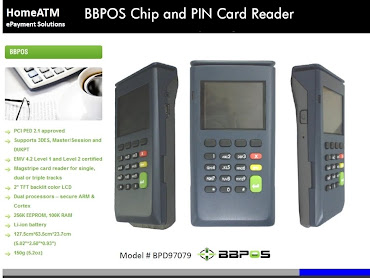
Chip and PIN eCommerce and Mobile

Chip and PIN eCommerce and Mobile
Click to Inquire

Kapersky Calls for Mass Adoption of Card Readers

Kapersky Calls for Mass Adoption of Card Readers

Translate This Blog

BobCaps

Search ePayment News (example: NFC)

About Me

My photo
Named one of the best Payment Industry News Blogs 4 Years Running

Feedjit

My Zimbio