All Top Banking

Showing posts with label Magnetic stripe card. Show all posts

Updated: Acculynk...Where's the PIN Offset? My Pet PVV

Posted by John B. Frank Monday, March 9, 2009 1 comments


Updated:  I just got off the phone with Chris A. Mark, CEO and Founder of the Aegenis Group and the Society of Secure Payment Professionals.  

Apparently,  John Stewart, Editor of Digital Transaction News, saw this post and called Chris to discuss a "hardware vs. software" approach.

I had our CEO, Ken Mages join us on the phone.  Chris is probably one of the foremost experts in PCI and payments security and 1 of about 20 people in the world who "truly" understands how a PIN transaction works, so since Ken is another 1 of the 20, it made sense for him to collaborate with Chris.

In fact, here's a little backgrounder on Mr. Mark:  Quite impressive to say the least... 

The Aegenis Group is led by

Chris MarkChris Mark, CISSP, CIPP; CEO/President and Founder

Mr. Mark is an experienced information security professional and PCIexpert. Over the past six years, Mr. Mark has worked in variousinformation security capacities within the payment services’ segment.Most recently, Mr. Mark was employed at MasterCard Worldwide where hewas one of MasterCard’s representatives on the Payment Card IndustrySecurity Standards’ Council (PCI-SSC)Technical Working Group. In addition to founding an informationsecurity company and conducting numerous PCI assessments for merchants,service providers, and members, Mr. Mark has worked with bothMasterCard Worldwide and Visa USA on components of their respectivedata security programs.

Mr. Mark is also contracted with Visa to train all of their majoracquirers and the top 3000 merchants in the PCI DSS. Prior to joiningthe civilian sector, Mr. Mark served in both the United States MarineCorps, where he operated as an elite Force Reconnaissance Marine andMarine Scout/Sniper, and in the US Navy where he was selected to serveas a Navy SEAL Officer. Subsequent to sustaining a career endingtraining injury, Mr. Mark served as the Training Officer and ChiefInstructor of the US Marine Corps Basic Reconnaissance Course where hewas responsible for screening, selecting, and training eliteReconnaissance Marine Candidates. Mr. Mark is a combat veteran ofOperation Continue Hope, Mogadishu, Somalia. Mr. Mark holds the CISSP,and CIPP professional certifications, numerous technicalcertifications, and has an MBA and BA degrees.


Here's an excerpt from an email he sent me:


John,

John Stewart from Digital Transactions called to ask about the differences in Home ATM and Acculink.  I was very clear that conceptually I feel HomeATM is a much better solution.
Please feel free to call me to discuss the article comments.

Chris
Chris A Mark, CISSP, CPISA, CPISM, CIPP
The Aegenis Group, Inc.


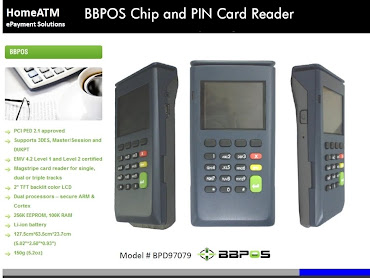
We spoke at length about the security of our solution and he was impressed enough to want to learn more and we are happy to provide him with anything and everything we can so that we can empower his analysis.  We agreed to FedEx him a SwipePIN device (pictured below) and we'll talk again after Ken gets back from the Merchant Risk Council meeting in Las Vegas on Thursday or Friday.   I'll provide an update.   Here's the rest of the story....


In an effort to prove that I am not alone in questioning the security of Acculynk's Floating PIN Pad I am going use a respected third party resource to back up my concerns... just in case people confuse common sense for competitive jealousy.  I assure you, I have none.  (common sense that is...lol)

In fact, in an act of fairness...I hereby extend an open invitation to any C-Level Executive at Acculynk to address the two questions highlighted on the graphic on the left.  I am more than happy to allow them the opportunity to set the record straight.  It is not my intention to berate their solution.  It IS my intention to prevent a future breach that makes Heartland's pale in comparison...which is exactly what would happen if hackers got their fraudy-little fingers on PIN's.

As I said, I've spoken to Acculynk President Nandan Sheth quite a few times over the course of the last year and have nothing but good things to say about the him. As a matter of fact, after taking my cell-phone off the charger, I see that I missed a call from him earlier this afternoon, so I owe him a return call...
   

The following is from the Society of Payment Security Professionals blog written by Chris A. Mark, CISSP, CPISA, CPISM, CIPP, Founder and CEO of The Aegenis Group.

In the article he published last October, Chris questioned the security of Acculynk's Floating PIN Pad. 
Online PIN Debit; Great Idea or Not so Great Idea?

The big questions he asked about (besides security) is that if a "card is not present" (CNP) i.e. in Acculynks model one must manually type in the credit or debit card's personal account number (PAN) and if it's determined that the card can be used with a PIN, then the floating PIN Pad GUI pops up.  The e-shopper then uses the floating PIN Pad to enter their PIN.  So...with no swipe...just type...they want to know: "Where is the PIN Verification Value (PVV) and where is the PIN Offset stored?"  Good questions!  In a traditional PIN Debit transaction (like the one that most closely mimics the consumer experience in a grocery store...
the PVV and PIN Offset is resident on the magnetic stripe.  No Swipe...No Stripe!  No Stripe...No PVV...NO PIN Offset.

Besides the fact that in 500+ breaches, software was 92 times more likely to be breached than hardware, those were two more very important reasons why HomeATM went with a Hardware based solution.   

Here's an excerpt from the Society of Security Professional Blog:

I (Chris) want to thank Susan Kohl for sending this over. Digital Transactions has published several articles on new technology that will allow PIN Debit for eCommerce sites. Read the article here.

In short, the new technology will present a buyer with a floating ‘PIN Pad’ on the screen. Users can then enter their PIN which will then allow the merchant to immediately debit the user’s account for payment. While the technology appears very compelling from a convenience perspective I have to admit that it also gives me pause. In my mind, there are a number of potential issues with this technology. I am sure (or at least hoping) the companies, banks and card brands are working through these issues but they merit discussion here anyhow.

From a security perspective, I am challenged by the technology. My first thought is key stroke logging and malicious software. Now I know people will likely say that this is possible with traditional eCommerce transactions. This is accurate. In this scenario, however, PIN data is being transmitted. As discussed in a previous entry, there may not be a limit to the liability associated with compromise of PIN data. It brings another question to light, as well.

If the transaction is a ‘card not present’ transaction then where is the PIN Verification Value / PIN Offset stored?

In a traditional PIN Debit transaction it is resident on the magnetic stripe of the card. This has several benefits one of which is that it prevents a data thief from obtaining a PIN and only the primary account number and being able to conduct PIN based transactions.

If the card is not required to be presented, it appears that this would allow fraudsters to obtain the PAN or other card data and the PIN and conduct transactions.

Editor's Note:  Holy Grail Batman!  See I'm not biased.  And I'm not alone with my "concerns." Do you have any?  As always, feel free to leave a comment.  Click on the title of the post, and the comments will be enabled on the bottom.  Have a salubrious weekend!   


Reblog this post [with Zemanta]

Gemalto Chippin' In with Venezuelan Bank Card Leaders

Posted by John B. Frank Friday, January 30, 2009 0 comments

Gemalto teams with Venezuelan bank card market leaders to accelerate EMV migration

Digital security provider Gemalto is teaming up with Corporación Cardtech, Venezuela’s largest supplier of magnetic stripe bank cards, and Newtech Solutions, a consulting and technical support organization that specializes in EMV to help banks in Venezuela move to the new, smart credit card that will better protect their customers from fraud and identity theft.  Under the new agreement, banks in Venezuela working with the two companies will have access to expertise, consulting services, smart cards and technology from Gemalto. The partners estimate that eight million cards will be issued in the first year, starting in June 2009. Close to 16 million debit and credit cards are currently in use in Venezuela.

"Venezuelan banks are faced with constantly increasing card fraud, mostly due to illegal copying of magnetic stripe information to create “cloned” credit cards. The problem, that affects all of Latin America, has led to a liability shift which penalizes card issuers and merchants that do not issue or accept EMV cards. This liability change for non-EMV cards becomes effective in Venezuela starting July 2009."

EMV cards, also known as Chip and PIN, include a microprocessor and software with security features that work together with the payment transaction authorization network to prevent card fraud and identity theft. Unlike with magnetic stripe only cards, smart card based transactions cannot be easily cloned, which is a primary source of fraud throughout Latin America.

Editor's Note:  While it's true that they can't be cloned and easily used" at a retail location, they  certainly can  be  "easily" cloned and used online.  This is because the magstripe is still present on the back of the smart cards and that is what is "lifted" when cloning a card.

That, in large part, is why UK Fraud is 14 times higher overseas, (see related stories below) and why 1 in 4 Brits have experienced credit or debit card fraud.  (and why Gemalto wants EMV in the US.)  Online Transactions (web based) are currently (and HATM can change that) Card Not Present transactions.

So in order to
protect both online shoppers and online retailers, online (PIN) debit should be utilized.  HomeATM is the only provider of such a solution  which has been deemed both PCI 2.0 compliant, and offers "End to End Encryption" on all of it's PIN Based Transactions. 


In addition, HATM is EMV ready and it's personal swiping device transforms Card Not Present transactions into Card Present transactions, adding a layer of security with two factor authentication. (what you have and what you know, the card and the PIN respectively)

HATM's end-to-end encryption protects the consumers PIN throughout the whole transaction, as it is NEVER in the clear.     

For more information on how HomeATM's PIN Based Transactions can benefit your organization, visit
www.homeatm.net


Reblog this post [with Zemanta]

Wanna Get Away? Get Banks OK in UK

Posted by John B. Frank Tuesday, January 13, 2009 0 comments

If you "wanna get away" and you live in the UK, make sure your bank nose..otherwise you'll have "slim pickin's" when it comes to payment options...

Travelers have been told that they need to inform their banks about their travel destinations, when they go away, according to a recent report in the newspaper The Times.

This is in the aim of combating credit card fraud, where several holiday goers found their debit or credit cards frozen, when they are abroad. Banks monitor card usage and often freeze them if they begin showing unusual behavior.

The banks claim that if customers inform them of their travel plans, then it means they can make a proper assessment of the information. HBOS told the newspaper, saying: “If people are going to Africa, South America, we like to know. Also, we like to know about people going to Eastern Europe.” This is due to the increase of credit card fraud taking place in these locations.


However, locations in the United States are said to be the most likely places that involve fraud with British cards. Around £24.6 million was taken from UK cardholders in the country in 2008, marking an increase of 118 percent in the last three years. Much of this fraud is conducted by criminals who copy the information on the card's magnetic strip when it is used. They can then use this information to create fake cards for their own use. Credit card fraud has become less likely in the UK, due to the introduction of Chip and PIN.


Reblog this post [with Zemanta]

U.K. Blames Abroad for Increased Fraud

Posted by John B. Frank Thursday, October 2, 2008 0 comments

Some people say there's a woman to blame, but I know...it's my own damn fault
- Jimmy Buffet


"PIN's Blame Abroad...They're Not Smart...Oui Are"

After 3 years of dismal results from the highly heralded Chip and PIN platform, which embeds circuits (Smart card) onto the card, is this the beginning of a propaganda-laced campaign by APACS aimed at deflecting criticism off their (what might be aptly renamed "Phish and Chip") program?

According to every published article I've read, the common denominator is "It's not their fault...it's the countries that haven't followed their lead and incorporated a Chip and PIN system". So they're waiting for everyone else to "get smart" cards and then it'll be OK. Unfortunately for APACS, the US has absolutely no designs on incorporating that system, thus it looks like APAC'SOL. "Sorry about that chief"...

Here's a collage of information from various UK media outlets spewing their spin on the failed ability of Chip and PIN to reduce fraud.

To see APACS report click here

According to APACS, fraud losses for debit and
credit cards increased to £307 million in the UK - compared to £267 million over the same period last year. This is a 13 percent rise.

The total amount lost to the fraudsters reached a record £301.7 million in the first half of the year - more than before chip and pin security was introduced in 2006. £121.2million - or 40 per cent of the total - involved fraud committed on cloned or stolen UK cards using cash machines abroad, a 190 per cent rise in just three years.

The figures were boosted in particular by overseas fraud, which made up 40 percent of the total. Phone, internet and mail order scams were another pressure point, fraud from which rose 18 percent to £162 million.

While card fraud fell from £219.5million in 2005 to £209million in the first half of 2006 following the start of chip and pin, it rose to £263.6million in 2007.

Although the banking industry insisted that card fraud would have continued to rise sharply if chip and pin had not been introduced, in reality it has provided only a temporary halt, with fraudsters finding new - and more lucrative - ways to operate.

Last month, police warned that many gangs have installed fake
chip and PIN readers in small shops and petrol stations to record the information on a credit card's magnetic stripe. A security camera then notes the customer's PIN before the card is cloned and used at a cash machine, usually abroad. Police suspect the money raised is not only fueling the activities of international criminal gangs involved in drug running and prostitution, but also terrorism

However, Sandra Quinn, of APACS, insisted: 'Criminals continue to target those areas where we do not currently have the security benefits of chip and pin, causing increases in fraud abroad and phone, internet and mail order shopping fraud.

"Fraud abroad will be more difficult for criminals to commit as more countries roll-out chip and pin. (Last I heard, the US isn't going to spend the billions of dollars needed to roll out that program, so I would translate that as "Fraud abroad will continue to be easy for criminals...)

"To help tackle online fraud, we urge shoppers to protect their computer with anti-virus software, only use secure websites and use systems that make cards more secure when shopping online."


Reblog this post [with Zemanta]

Powered by Blogger.

Search This Blog

Our Manufacturing Facility

Learn More About Us

Find out how our patented technology can empower your financial institution.

Our secure two-factor online banking authentication eliminates dangerous passwords and usernames and replicates the same trusted process used to access cash at ATM's. (Insert Bank Issued Card, Enter Bank Issued PIN)

There is an R.O.I. as FI's also earn recurring revenue from each transaction conducted using our PCI 2.0 Certified PIN Entry Device. Our technology also provides a unique real-time P2P "Instant-Transfer" which allows your online banking customer to transfer cash from ANY of their bankcards to ANY other bankcard...with the Swipe of a card.

Help your bank eliminate phishing and your customers avoid identity theft by providing them with the ability to stop typing and start swiping. There is no safer way to conduct financial transactions online than by 3DES DUKPT encrypting the cardholder details, which we do at the mag-head "inside the box/outside the browser."

Total Pageviews

SLIM for PC or SmartPhone

SLIM for PC or SmartPhone
Click to Inquire

Chip and PIN eCommerce and Mobile

Chip and PIN eCommerce and Mobile
Click to Inquire

Kapersky Calls for Mass Adoption of Card Readers

Kapersky Calls for Mass Adoption of Card Readers

Translate This Blog

BobCaps

Search ePayment News (example: NFC)

About Me

My photo
Named one of the best Payment Industry News Blogs 4 Years Running

Feedjit

My Zimbio